HOUSING MARKET
March 24, 2026 · 5 min read
Greg Rutolo | NMLS # 34860 | email gregory.rutolo@loanfactory.com
Your rent feels astronomical for a reason. You’re not imagining it. In some states, you may be paying nearly double the national average. Across the United States, the gap between the most and least expensive rental markets has never been wider. Understanding where rents are highest, and why, is essential for renters, policymakers, and anyone thinking about where to live next.
The most expensive states
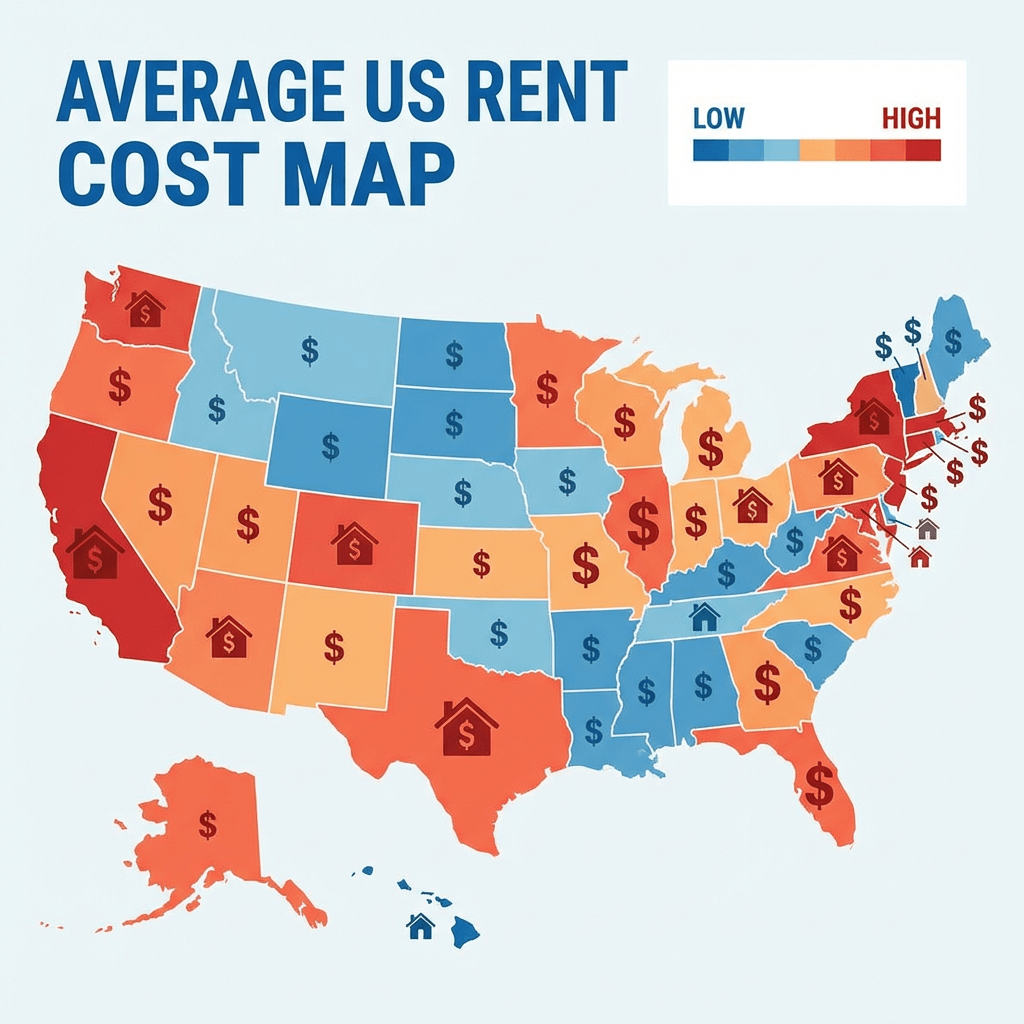
Hawaii tops every ranking, with average monthly rents around $2,399 — a staggering 53% above the national average of $1,563. California follows closely at $2,207, with Massachusetts ($2,100), New York ($2,050), and New Jersey ($1,985) rounding out the top five. All five states share a common thread: dense coastal geography, high-wage economies, and severe constraints on new housing supply.
Maryland, Washington, Connecticut, Alaska, and Virginia finish the top ten, with average rents ranging from $1,801 to $1,940 per month. Notably, none of these states are landlocked — geographic limits on buildable land are a recurring factor.
Why are rents so high in these states?
Several overlapping forces drive rental costs to these extremes. First, strong labor markets attract workers. California anchors the tech industry. Massachusetts anchors the biotech industry. Meanwhile, New York remains a global finance hub. High salaries fuel demand for housing, pushing rents upward. Second, geography constrains supply. Hawaii is an island. California is hemmed in by the Pacific Ocean and mountain ranges. In these, and many other places, buildable land is simply scarce.
Third — and perhaps most controversial — restrictive zoning laws in these states have historically limited multifamily construction. Local opposition to new development (sometimes called “NIMBYism”) has kept housing stock tight even as populations and job markets grew. The result is a textbook supply-demand mismatch that shows no sign of resolving quickly.
What this means for renters
For the 44 million renter households in America, these figures translate to real financial strain. Housing experts recommend spending no more than 30% of gross income on rent. In Hawaii or California, a renter would need to earn over $95,000 a year to meet that benchmark. This amount is well above the median household income in both states.
The ripple effects extend beyond individual budgets. High rents are accelerating domestic migration, with renters leaving expensive coastal states for lower-cost alternatives in the South and Midwest. Cities like Austin, Nashville, and Raleigh have absorbed much of this population shift. As a result, their rents have risen sharply.
The other side of the map
For context, states like West Virginia, Mississippi, and Arkansas have average rents close to $900–$1,000 per month. This is less than half of what renters pay in Hawaii. These markets offer affordability, but often come with fewer job opportunities and different infrastructure challenges. The United States, in short, has two very different rental economies operating simultaneously.
What’s next?
Several expensive states have begun reforming zoning rules to allow more housing construction. California has passed landmark legislation to override local bans on multifamily housing near transit. Massachusetts has similarly pushed towns to zone for more density. It remains to be seen whether these measures will meaningfully move the needle on rents. Housing supply takes years to respond to policy changes.
In the meantime, for renters in the nation’s priciest states, the math remains brutal. Knowing which forces drive your rent is the first step. Understanding which states are doing something about it is also crucial. Together, these insights help you understand one of America’s most pressing economic challenges.
—
Data sources: U.S. Census Bureau, HUD, rentdata.org, worldpopulationreview.com
 Greg Rutolo | Loan Factory
Leave a comment